10 K-drama phrases you already know (and how to read them in Hangul)
If you've watched more than three Korean dramas, you already have a vocabulary — you just can't read it yet. These ten lines show up in nearly every series. Here they are in Hangul, with romanization, what they literally mean, and the moment they get said.
| Korean | Sounds like | Meaning · when | Level |
|---|---|---|---|
| 안녕하세요 | annyeonghaseyo | Hello. The one greeting that works with everyone, any time of day. | polite |
| 좋아해요 | joahaeyo | I like you. The classic confession line. Softer than 사랑해요. | polite |
| 내가 지켜 줄게 | naega jikyeo julge | I'll protect you. Peak male-lead line. Usually said in the rain. | casual |
| 그런 뜻이 아니야 | geureon tteusi aniya | That's not what I meant. The line before every misunderstanding gets worse. | casual |
| 밥 먹었어요? | bap meogeosseoyo? | Have you eaten? The Korean 'how are you'. Answer 네 even if you haven't. | polite |
| 치맥 먹자 | chimaek meokja | Let's have chicken and beer. 치킨 + 맥주 = 치맥. A national institution. | casual |
| 대박! | daebak! | Awesome! / No way! Good news or shocking news — both work. | casual |
| 어떡해 | eotteokae | What do I do? / Oh no. Contraction of 어떻게 해. Panic in three syllables. | casual |
| 울지 마 | ulji ma | Don't cry. Said while wiping tears with a thumb. | casual |
| 기다릴게 | gidarilge | I'll wait for you. The promise that carries a 16-episode gap. | casual |
The three speech levels, in one paragraph
Korean changes its endings depending on who you're talking to. Casual (반말) drops the -요: 사랑해, 미안해 — for partners, close friends, younger people. Polite (-요) is the safe default: 사랑해요, 미안해요. Formal (-습니다) is for bosses, customers and first meetings: 죄송합니다, 감사합니다. Dramas switch between all three, and the switch itself is often the plot — the moment a character drops the -요 is the moment they've become close.
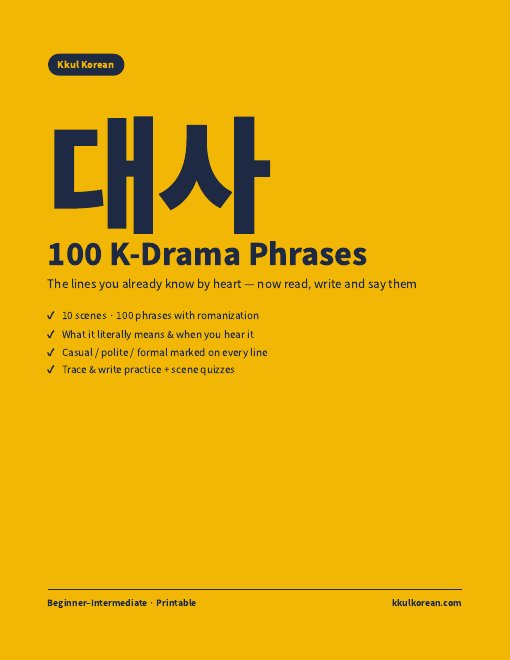
100 K-Drama Phrases
Ten scenes — first meetings, falling in love, fights, food, the office, texting slang, goodbyes — 100 lines with the moment each one gets said, plus tracing grids to write them. 36 pages.
See it · $6.90